The Minotaur
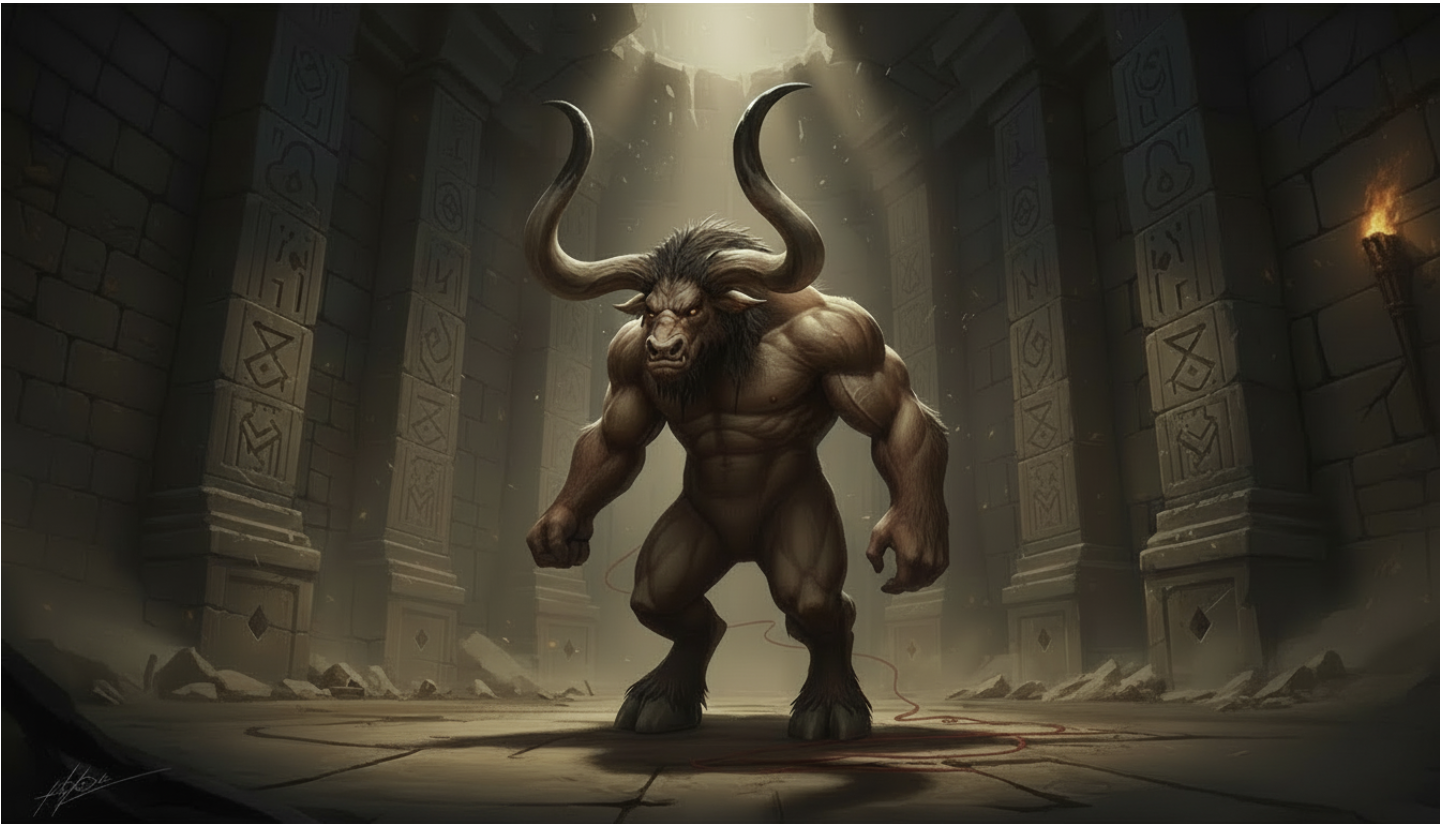
King Minos of Crete sought to prove his divine right to rule. He prayed to Poseidon, the Sea God, for a majestic bull. King Minos said that he would sacrifice the bull as an offering to the Gods. Poseidon granted this wish and sent King Minos a pristine white bull. King Minos thought the bull was so beautiful that he decided to keep it instead, and sacrifice a different bull.
As punishment, Poseidon made Queen Pasiphaë (King Minos’ wife) fall in love with the bull. From this unnatural relationship, the minotaur, a half man, half bull creature, was born. Minos commissioned Daedalus, a brilliant inventor, to build the labyrinth, an inescapable maze beneath their palace in Knossos. This was done to imprison the minotaur, so it would never see daylight again.
After a conflict with Athens, King Minos demanded a recurring tribute. Seven Athenian youths and seven Athenian maidens were to be sent to Crete as food for the Minotaur to enjoy.
Theseus, the Prince of Athens, volunteered to join the tributes. He intended to slay the monster and end the horrible slayings. Upon arrival in Crete, Ariadne, daughter of Minos, fell in love with Theseus and decided to secretly help him. She gave him a ball of thread, enabling him to trace his path inside the labyrinth. Theseus entered the maze and navigated its dark corridors. Theseus spotted the minotaur and they had a ferocious battle in its lair. After a fierce struggle, Theseus killed the minotaur with his sword. This ended the countless deaths of Athenian tributes in Crete.
Theseus retraced his steps using Ariadne’s thread and escaped the labyrinth with the other Athenian youths. Theseus, with Ariadne and the other youths, fled Crete, but later on abandoned Ariadne on the island of Naxos. On return to Athens, Theseus forgot to change his ship’s black sails to white—the signal of success. Seeing the black sails, King Aegeus believed his son had died, and threw himself into the sea, which was thereafter named the Aegean Sea.
In the end, Theseus became king, but his triumph was shadowed by loss, guilt and the weight of leadership. .